
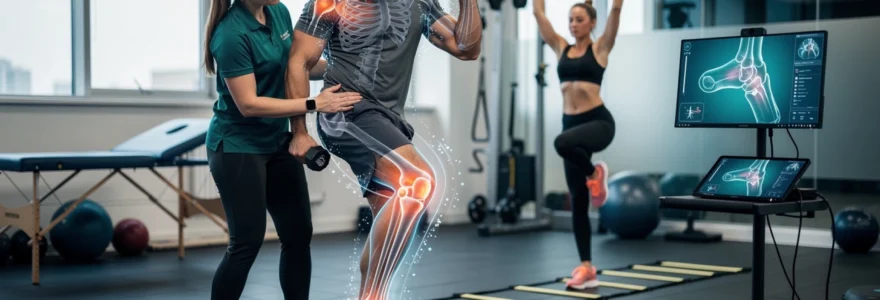
Joint stability serves as the cornerstone of safe and effective physical activity, functioning as the body’s primary defence mechanism against exercise-related injuries. Every movement you perform relies on the intricate balance between mobility and stability across multiple joint systems. When this delicate equilibrium is disrupted, the risk of acute injuries and chronic conditions increases exponentially. Understanding the fundamental principles of joint stability empowers athletes, fitness enthusiasts, and healthcare professionals to develop more effective injury prevention strategies that address the root causes of musculoskeletal dysfunction.
The complexity of joint stability extends far beyond simple structural support, encompassing sophisticated neuromuscular control systems that adapt continuously to changing demands. Active stability emerges from coordinated muscle contractions, whilst passive stability relies on static structures such as ligaments and joint capsules. This dual system creates a dynamic framework that allows for both controlled movement and protective restraint when necessary.
Anatomical foundations of joint stability mechanisms
The architectural design of human joints reflects millions of years of evolutionary adaptation to movement demands. Each joint possesses unique structural characteristics that influence its stability profile, creating a sophisticated hierarchy of support systems. Ball-and-socket joints like the hip demonstrate inherent structural stability through deep acetabular coverage, whilst hinge joints such as the knee rely more heavily on soft tissue restraints and muscular coordination.
Proprioceptive feedback systems and mechanoreceptor function
Proprioceptive mechanisms form the neurological foundation of dynamic joint stability through specialised mechanoreceptors embedded within joint capsules, ligaments, and surrounding musculature. These sensory organs continuously monitor joint position, movement velocity, and tissue deformation, providing real-time feedback to the central nervous system. Ruffini endings respond to sustained stretch and joint position, whilst Pacinian corpuscles detect rapid movement and vibration.
The integration of proprioceptive information occurs at multiple levels of the nervous system, from spinal reflexes to cortical processing centres. Research indicates that proprioceptive deficits significantly increase injury risk, particularly in athletes returning from previous joint injuries. Neuromuscular training programmes that challenge proprioceptive systems demonstrate remarkable efficacy in reducing subsequent injury rates across various sports populations.
Ligamentous structures and passive stability components
Ligamentous restraints provide the primary line of defence against excessive joint motion, functioning as biological safety cables that engage at end-range positions. The anterior cruciate ligament exemplifies this concept, preventing anterior tibial translation and rotational instability during high-demand activities. However, relying excessively on passive restraints places these structures at significant risk of failure, particularly when active muscular control is insufficient.
The viscoelastic properties of ligaments influence their protective capacity, with loading rate and tissue temperature affecting their mechanical behaviour.
Passive stability mechanisms represent the last resort for joint protection, engaging only when active control systems are overwhelmed or compromised.
This understanding emphasises the critical importance of developing robust active stability systems to prevent over-reliance on passive structures.
Muscular co-contraction patterns in dynamic stabilisation
Muscular co-contraction represents the gold standard of joint protection, involving simultaneous activation of agonist and antagonist muscle groups to create dynamic stability. This mechanism allows for precise control of joint motion whilst maintaining protective tension around the articulation. The timing and magnitude of co-contraction patterns adapt based on task demands, movement velocity, and perceived threat levels.
Research demonstrates that trained athletes develop more sophisticated co-contraction strategies compared to recreational exercisers, resulting in superior joint protection during high-intensity activities. Anticipatory muscle activation occurs prior to ground contact during jumping activities, preparing joints for impact forces. This pre-activation strategy significantly reduces injury risk by ensuring adequate muscular support before external loads are applied.
Capsular tension and joint congruency factors
Joint capsules provide both structural support and proprioceptive feedback through their rich innervation patterns. Capsular tension varies throughout range of motion, contributing to the overall stability profile of each joint. The relationship between joint congruency and stability becomes particularly evident in ball-and-socket joints, where
the depth of the socket and the orientation of articular surfaces greatly influence how well forces are distributed. When joint congruency is high, load is shared over a larger surface area, reducing peak stresses on cartilage, ligaments, and subchondral bone. Conversely, reduced congruency or malalignment, as seen in conditions like femoroacetabular impingement or shallow glenoid sockets, increases shear forces and demands more from active muscular stability to prevent injury.
Capsular tension also plays a crucial role in maintaining the “centre” of joint rotation during complex movements. Think of it as a carefully tensioned tent structure: when all guy ropes are equally engaged, the tent stands firm even under wind load; when one side is slack, the whole structure becomes vulnerable. In the same way, balanced capsular tension and joint congruency support smooth, predictable arthrokinematics, allowing muscles to fire efficiently and reducing the likelihood of microtrauma during repetitive exercise.
Biomechanical analysis of common exercise-related joint injuries
Understanding how joint stability breaks down in real-world scenarios is key to preventing exercise-related injuries. Rather than viewing injuries as isolated events, we can analyse the interplay between passive structures, active muscular control, and external forces. Each joint has characteristic failure patterns that tend to emerge when stability systems are overloaded or poorly coordinated. By examining these patterns, we can design exercise programmes that specifically target the weak links in joint stability.
Modern sports medicine research consistently shows that joint injuries rarely occur due to a single factor. Instead, they arise from a convergence of biomechanical errors, fatigue, previous injury history, and environmental influences such as surface type or footwear. When you recognise these multi-factorial interactions, you can shift from a purely reactive approach to a more strategic, proactive model of injury prevention during training.
Anterior cruciate ligament ruptures during plyometric training
Anterior cruciate ligament (ACL) ruptures provide a classic example of failed joint stability during high-demand tasks such as plyometric jumps and cutting manoeuvres. Non-contact ACL injuries often occur within 40 milliseconds of ground contact, long before conscious corrections are possible. At this moment, the knee is exposed to a dangerous combination of valgus collapse, internal tibial rotation, and insufficient hamstring co-contraction to counteract anterior tibial translation. If active stability is inadequate, the passive ligamentous system is forced to absorb forces beyond its capacity.
Biomechanical analyses have revealed that poor trunk control, hip adductor weakness, and delayed gluteal activation all contribute to unfavourable knee loading patterns. Female athletes, for example, exhibit higher ACL injury rates, partly due to differences in neuromuscular control and landing mechanics. When you see an athlete land with a “knock-kneed” posture and stiff hip strategy, you are witnessing a breakdown in active stabilisation that places immense strain on the ACL. Structured plyometric training that emphasises soft landings, proper knee alignment, and anticipatory hamstring activation can markedly reduce these risks.
Glenohumeral instability in overhead athletes
The glenohumeral (shoulder) joint sacrifices inherent bony stability in favour of extensive mobility, making it particularly reliant on dynamic stabilisers. Overhead athletes such as swimmers, volleyball players, and weightlifters subject this joint to repetitive high-velocity or high-load motions. When the rotator cuff and scapular stabilisers fail to provide adequate compression and centring of the humeral head in the glenoid fossa, micro-instability develops. Over time, this can manifest as labral tears, tendinopathy, or recurrent subluxations.
From a biomechanical perspective, glenohumeral instability often accompanies scapular dyskinesis, where the shoulder blade fails to upwardly rotate, posteriorly tilt, or externally rotate effectively during elevation. Imagine trying to throw a ball from a moving, unstable platform—your accuracy and control would suffer. In the same way, if the scapula does not provide a stable base, the humeral head will translate excessively, overloading the capsule and labrum. Targeted strengthening of the rotator cuff, lower trapezius, and serratus anterior, combined with careful load management, is essential for injury prevention in overhead exercise programmes.
Ankle inversion sprains in multi-directional sports
Ankle inversion sprains are among the most common sports injuries, particularly in activities that demand rapid changes of direction, such as basketball, football, and tennis. These injuries usually occur when the foot lands on an uneven surface or another player’s foot, causing rapid inversion and plantarflexion. If the peroneal muscles fail to activate quickly enough, the lateral ligaments of the ankle—especially the anterior talofibular ligament—are forced into a passive stabilising role at end range. When the applied torque exceeds their tensile strength, a sprain or rupture occurs.
Crucially, previous ankle sprains often lead to proprioceptive deficits and delayed peroneal reaction times, creating a vicious cycle of recurrent injury. You can think of a previously sprained ankle as a smoke alarm with a delayed response; by the time it “detects” danger, damage is already underway. Neuromuscular training that challenges balance, reaction speed, and active ankle stability under unpredictable conditions is therefore indispensable. Incorporating single-leg landings, lateral hops, and perturbation drills into exercise programmes helps restore the rapid co-contraction patterns needed to protect the joint.
Lumbar spine hypermobility during loaded movements
The lumbar spine is designed primarily for stability rather than excessive mobility, yet many gym-based movements expose it to repeated flexion, extension, and rotational stresses under load. When the deep stabilising system—particularly the multifidus, transverse abdominis, and diaphragm—does not activate appropriately, the lumbar segments may move excessively relative to one another. This segmental hypermobility increases shear forces on intervertebral discs, facet joints, and passive ligaments during exercises like deadlifts, bent-over rows, and heavy squats.
Poor hip mobility and inadequate core control commonly drive compensatory lumbar motion. For instance, if hip flexion is restricted, an athlete may “borrow” movement from the lumbar spine when attempting to reach the bar in a deadlift, rounding the lower back and compromising joint stability. Over time, this pattern can contribute to disc herniations or chronic low back pain. Emphasising neutral spine alignment, bracing strategies, and adequate hip and thoracic mobility before loading heavy lifts is essential for protecting lumbar joint structures during exercise.
Evidence-based stability training protocols
To meaningfully reduce injury risk during exercise, joint stability training must go beyond generic strengthening and address the neuromuscular systems that control movement under stress. Evidence-based protocols combine proprioceptive challenges, progressive instability, and sport-specific demands to cultivate robust active stability. The aim is not to eliminate movement variability, but to enhance your ability to maintain control when conditions change suddenly—just as they do in sport and real life.
Across multiple studies, neuromuscular and balance training programmes have been shown to reduce lower limb injuries by 30–50% when consistently implemented. These programmes typically feature perturbation drills, multi-planar movements, and reactive tasks that stimulate co-contraction and anticipatory control. When you systematically progress these elements, you teach your joints not only to be strong, but also to be smart under pressure.
Neuromuscular re-education through perturbation training
Perturbation training involves exposing the body to unexpected disturbances while performing functional tasks, forcing rapid adjustments in muscle activation. Examples include manual pushes from a therapist or coach, moving loads such as water-filled implements, or unstable cables that change direction unpredictably. The objective is to enhance reflexive stability rather than conscious, delayed corrections. In essence, you are training the body’s “autopilot” to react faster and more effectively to potential threats.
Research in post-ACL reconstruction populations has shown that structured perturbation training improves knee kinematics and reduces giving-way episodes more effectively than traditional strength training alone. By challenging the proprioceptive system with variable, multi-directional forces, you encourage more efficient co-contraction and better joint positioning. For general exercisers, integrating controlled perturbations—such as gentle pulls on a resistance band during squats or lunges—can significantly improve joint stability during everyday training sessions.
Progressive instability surface progressions
Instability surface training uses tools such as foam pads, balance discs, or wobble boards to challenge joint stability and proprioceptive control. However, the key is progression; excessive instability too early can degrade movement quality and encourage compensatory patterns. A sensible approach starts with stable, ground-based exercises that emphasise correct alignment and muscular co-contraction, then gradually introduces mild instability as technique and control improve.
For example, a progression for ankle stability might move from double-leg stance on the floor, to single-leg stance, then to single-leg stance on a foam pad, and finally to dynamic tasks like reaches or ball catches on an unstable surface. This stepwise approach respects the principle of “challenge without chaos,” ensuring that instability enhances neuromuscular control rather than overwhelming it. When applied thoughtfully, progressive instability surfaces can significantly improve joint stability in a safe, structured manner.
Sport-specific balance challenge protocols
While general balance training has value, the most effective joint stability programmes reflect the specific demands of your chosen activity. Sport-specific balance challenge protocols replicate typical movement patterns, force directions, and time pressures experienced in that sport. A tennis player, for instance, may practise single-leg balance while performing lateral reaches that mimic wide shots, whereas a runner might focus on forward–backward perturbations that simulate uneven terrain.
By aligning stability training with actual performance tasks, you improve the transfer of neuromuscular adaptations to real-world situations. This is similar to rehearsing lines in the same environment and emotional state as a performance—you are more likely to respond correctly under pressure. Incorporating tools such as medicine balls, sport-specific footwear, and directional cues can further refine these protocols, helping athletes manage joint loads safely while enhancing performance.
Reactive stabilisation drills for injury prevention
Reactive stabilisation drills place a premium on rapid decision-making and immediate muscular responses, bridging the gap between controlled exercises and chaotic sport environments. These drills often combine visual or auditory cues with sudden changes in direction, speed, or load. For example, an athlete may perform lateral hops and immediately change direction based on a coach’s call, or stabilise a water-filled device that shifts unpredictably during a lunge. The common thread is that the joint must stabilise reflexively under conditions of uncertainty.
Such drills are particularly effective for addressing the time-critical nature of many injuries, which often occur faster than conscious control can intervene. By improving the latency and coordination of stabilising muscle responses, reactive drills enhance your capacity to maintain joint alignment when unexpected perturbations arise. For general gym-goers, simple variations—like catching an off-centre medicine ball during a squat or responding to random step directions during a warm-up—can provide powerful joint stability benefits without requiring complex equipment.
Clinical assessment tools for joint stability evaluation
Before you can design a targeted joint stability programme, you need an accurate picture of current function. Clinical assessment tools help identify deficits in passive structures, neuromuscular control, and movement patterns that may predispose someone to injury during exercise. These assessments range from hands-on joint integrity tests to instrumented biomechanical analyses, each offering unique insights into how a joint behaves under load.
Common clinical tests include ligamentous stress tests (such as Lachman or anterior drawer for the knee), apprehension tests for the shoulder, and anterior drawer or talar tilt tests for the ankle. These evaluate the integrity of passive restraints and detect excessive laxity or instability. Complementing these, movement screening tools like the Functional Movement Screen (FMS) or single-leg squat assessments reveal dynamic control issues such as valgus collapse, poor trunk stability, or asymmetrical loading. When combined, structural and functional assessments provide a comprehensive map of stability strengths and weaknesses.
Technological applications in stability enhancement
Advances in technology have expanded our ability to assess and train joint stability with greater precision. Wearable sensors, motion capture systems, and force platforms can quantify subtle deviations in joint movement and loading that are invisible to the naked eye. For example, inertial measurement units (IMUs) worn on the lower limbs can track knee valgus angles during jump landings, highlighting patterns associated with elevated ACL injury risk. This data can then guide specific corrective exercises and re-testing to monitor progress.
On the training side, interactive balance systems and virtual reality platforms provide engaging ways to challenge joint stability in a controlled environment. These tools offer real-time feedback on centre-of-pressure movement, reaction times, and movement accuracy, allowing you to adjust difficulty to maintain optimal challenge. Even simpler technologies, such as smartphone apps that measure single-leg stance time or hop test performance, can help track functional stability over time. When integrated thoughtfully into exercise programming, technology serves as a powerful ally in building and maintaining joint stability.
Integration of stability training within periodised exercise programmes
For joint stability training to deliver lasting benefits, it must be woven systematically into a periodised exercise programme rather than treated as an occasional add-on. Periodisation involves planning training variables—such as volume, intensity, and exercise selection—over time to optimise adaptations and reduce injury risk. Within this framework, stability training can be emphasised more heavily during preparatory phases, then maintained and refined as sport-specific or performance-focused phases progress.
In practical terms, early phases may prioritise low-load, high-control exercises that restore alignment, mobility, and baseline neuromuscular control. As competence improves, you can introduce more dynamic, multi-planar movements, perturbation drills, and reactive challenges that mirror performance demands. Stability-focused work often fits effectively into warm-ups, accessory blocks, or active recovery sessions, ensuring consistent exposure without overwhelming training time. By aligning stability training with overall training goals and fatigue cycles, you create a robust platform for performance while significantly reducing the likelihood of exercise-related joint injuries.
 Good health cannot be bought, but rather is an asset that you must create and then maintain on a daily basis.