
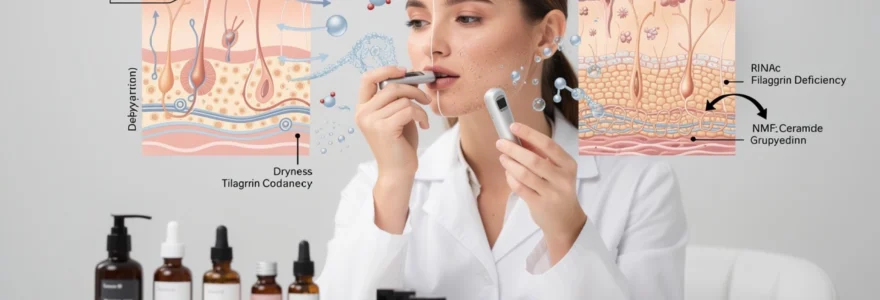
When your skin feels uncomfortable, tight, or visibly compromised, the instinctive reaction is often to reach for a rich moisturiser. Yet for many individuals, this approach yields disappointing results, with the discomfort returning within hours. The fundamental issue isn’t the product quality—it’s a misdiagnosis of the underlying condition. Dry skin and dehydrated skin, whilst sharing superficial similarities, represent entirely different dermatological states requiring distinct therapeutic approaches. This confusion affects treatment efficacy across millions of skincare routines globally, perpetuating a cycle of frustration and barrier dysfunction.
Professional estheticians and dermatologists recognise that identifying whether your skin lacks lipids or water forms the cornerstone of effective treatment. The distinction influences every product selection, from cleanser formulation to occlusive choice, ultimately determining whether you achieve genuine barrier restoration or merely temporary surface improvement. Understanding these conditions at a cellular level empowers you to make informed decisions that deliver measurable, lasting results rather than fleeting cosmetic enhancement.
Dermatological distinction: decoding dehydrated versus dry skin at the cellular level
At its core, the distinction between these conditions lies in their fundamental nature: dry skin represents a chronic skin type characterised by insufficient sebaceous gland activity, whilst dehydration constitutes a transient condition affecting water content within the stratum corneum. Dry skin, clinically termed xerosis, results from genetically determined or age-related reductions in lipid synthesis. The sebaceous glands produce inadequate quantities of sebum—the skin’s natural protective oil—leading to a compromised lipid barrier. This deficiency manifests consistently across the entire integumentary system, often affecting hands, scalp, and body skin simultaneously.
Dehydrated skin, conversely, can afflict any skin type, including those with robust sebaceous activity. An individual with naturally oily skin may simultaneously experience dehydration, creating the paradoxical presentation of surface shine alongside tightness and textural irregularity. This condition reflects insufficient water retention within the epidermis, typically precipitated by environmental stressors, aggressive skincare protocols, or lifestyle factors. The stratum corneum’s capacity to bind and retain water becomes impaired, yet sebaceous gland function remains unchanged. Approximately 68% of individuals who self-diagnose as having « dry skin » actually present with dehydration, according to recent dermatological surveys.
The cellular mechanisms underlying these conditions differ substantially. Dry skin involves disruption to the lipid lamellae—the organised bilayers of ceramides, cholesterol, and fatty acids that cement corneocytes together. Without adequate lipid synthesis, these structural components become depleted, creating microscopic gaps through which moisture readily escapes. Dehydrated skin, however, typically maintains intact lipid structures but suffers from dysfunction in hygroscopic components—substances that attract and hold water molecules. When natural moisturising factors (NMF) become compromised through environmental or chemical insults, the skin loses its capacity to maintain hydration despite normal barrier lipid levels.
Recognition of these mechanistic differences fundamentally alters treatment strategy. Addressing lipid deficiency requires introduction of exogenous oils and barrier-repairing constituents that physically replace missing structural elements. Treating dehydration necessitates restoring water-binding capacity through humectants whilst preventing transepidermal water loss through appropriate occlusives. Mismatching the treatment to the condition—applying heavy oils to dehydrated skin or lightweight gels to genuinely dry skin—not only proves ineffective but may exacerbate underlying issues, potentially triggering congestion, inflammation, or accelerated barrier degradation.
Transepidermal water loss (TEWL) and compromised skin barrier function
Transepidermal water loss represents the passive diffusion of water from the dermis through the epidermis to the surrounding atmosphere. In healthy skin, TEWL rates remain relatively constant, typically measuring between 4-8 g/m²/h under standard environmental conditions. However, when barrier function becomes compromised—whether through lipid deficiency or impaired water-binding mechanisms—TEWL rates escalate dramatically, sometimes exceeding 25 g/m²/h in severely affected individuals. This accelerated water loss creates the characteristic tightness
and discomfort associated with both dry and dehydrated skin. In practical terms, elevated TEWL is the physiological bridge that links what you feel on the surface—tightness, flaking, stinging—to what is happening microscopically within the barrier layers. By understanding and reducing TEWL, you are not simply making the skin feel better for a few hours; you are actively restoring its ability to regulate moisture, resist irritants, and maintain long-term resilience.
Measuring TEWL rates: corneometer and evaporimeter assessment techniques
In clinical and research settings, TEWL is not assessed by guesswork or visual inspection alone. Two primary non-invasive devices—the evaporimeter and the corneometer—provide quantitative measurements that help differentiate dry skin from dehydrated skin. An evaporimeter measures the water vapour flux from the skin surface, offering a direct reading of TEWL in g/m²/h, while a corneometer evaluates stratum corneum hydration by assessing electrical capacitance. Together, these instruments reveal whether moisture loss is driven by impaired barrier lipids, reduced water content, or a combination of both.
For example, a patient may present with normal corneometer readings but significantly elevated TEWL on evaporimetry, suggesting that water is present but escaping too quickly through a disrupted barrier—more typical of lipid-deficient dry skin. Conversely, low corneometer values with only mildly elevated TEWL often indicate dehydration, where the barrier is relatively intact but the water reservoir within the stratum corneum is depleted. While you may not have access to such devices at home, understanding that dermatologists can measure these parameters underscores why professional assessment can be invaluable when chronic dryness or dehydration does not respond to over-the-counter products.
Ceramide depletion and lipid barrier disruption in xerosis
Ceramides constitute approximately 50% of the intercellular lipids in the stratum corneum, forming the mortar that surrounds the “brick” corneocytes. In xerosis (clinically dry, lipid-deficient skin), studies consistently show a reduction in specific ceramide subclasses, particularly ceramide 1 and 3, which are critical for barrier integrity. When these lipids are depleted, the lamellar structure becomes disorganised, creating microscopic channels that accelerate water escape and increase susceptibility to irritants and allergens. This is why dry skin often presents with both scaling and heightened reactivity to products or environmental changes.
From a treatment perspective, replenishing ceramides is not simply about adding an emollient layer for comfort; it is about reconstructing the skin’s architectural framework. Modern moisturisers targeting dryness frequently include synthetic or bioidentical ceramides, cholesterol, and free fatty acids in ratios that mimic healthy skin. When you consistently apply these formulations, you are effectively patching holes in a damaged wall, gradually reducing TEWL and improving texture, elasticity, and comfort over time. For individuals with chronic xerosis or conditions such as atopic dermatitis, ceramide-focused care is often a long-term, non-negotiable element of their routine.
Aquaporin-3 channels and dermal hydration regulation
Beyond the lipid matrix, water distribution within the epidermis depends heavily on specialised membrane proteins called aquaporins. Among them, Aquaporin-3 (AQP3) plays a pivotal role in transporting water and glycerol from the deeper layers toward the stratum corneum. Reduced expression or function of AQP3 has been linked to diminished epidermal hydration, delayed barrier recovery, and increased sensitivity—all hallmarks of dehydrated skin. In simple terms, even if your barrier lipids are intact, suboptimal aquaporin activity can leave the upper layers of skin feeling depleted and tight.
Interestingly, some skincare actives appear to influence AQP3 expression. Glycerin, for example, not only functions as a humectant at the surface but also serves as a substrate for AQP3, enhancing water and glycerol transport when these channels are functioning well. Certain botanical extracts and niacinamide have also been shown in small studies to support aquaporin regulation, although this area is still emerging. When you select hydrating products that combine humectants with barrier-supportive ingredients, you are effectively working with the skin’s own transport systems rather than just coating the surface.
Filaggrin gene mutations and natural moisturising factor deficiency
Another crucial player in skin hydration is filaggrin, a structural protein that helps organise keratin filaments in the epidermis and, upon degradation, contributes to natural moisturising factor (NMF). NMF is a complex mixture of amino acids, urea, lactate, and salts that bind and retain water within the stratum corneum. Individuals with loss-of-function mutations in the filaggrin gene (FLG) tend to produce less NMF, which directly weakens the skin’s capacity to hold water, increasing TEWL and predisposing them to atopic dermatitis and chronic dryness. In such cases, dryness and dehydration often coexist, creating a particularly fragile and reactive barrier.
If you have a history of eczema, widespread roughness, and persistent sensitivity, a filaggrin-related NMF deficit may be a contributing factor, even if it has never been formally diagnosed. While topical products cannot correct the gene mutation itself, formulations rich in humectants (such as urea and amino-acid complexes) and barrier lipids can compensate functionally by mimicking NMF and strengthening the lipid matrix. This is one reason why seemingly simple changes—like introducing a urea-based cream—can produce dramatic improvements in comfort and hydration for those with genetic predispositions to dryness.
Clinical presentation: visual and tactile markers of each condition
From a clinical standpoint, differentiating dry versus dehydrated skin relies on more than subjective descriptors like “tight” or “itchy.” Dermatologists and advanced estheticians use a combination of visual cues, palpation, and patient history to characterise the pattern of moisture deficiency. Dry, lipid-depleted skin often appears dull, rough, and flaky across multiple body areas, with fine scaling that persists regardless of immediate environment. Dehydrated skin tends to fluctuate more, presenting as occasional dullness, fine “criss-cross” lines, and a sensation of tightness after cleansing that may ease as the day progresses but return with environmental stress.
When you examine your own skin, note whether the discomfort is constant or situational, and whether heavier creams truly resolve the issue or merely soften the surface temporarily. Does your skin feel uniformly dry from face to shins, or is the sensation concentrated on the face with episodes that come and go? By paying attention to these patterns, you can begin to recognise whether your skin is fundamentally lacking oil, water, or both—and align your skincare routine accordingly rather than relying on guesswork or product marketing claims.
Dehydration lines versus static wrinkles: identifying temporary skin texture changes
One of the most common sources of confusion is the appearance of fine lines. Are you seeing early signs of intrinsic ageing, or are these dehydration lines that can improve rapidly with proper hydration? Dehydration lines usually present as fine, shallow, mesh-like creases, particularly around the eyes, cheeks, and forehead. They often appear more pronounced after travel, illness, seasonal changes, or increased use of exfoliants and retinoids. When you apply an effective hydrating serum followed by a suitable moisturiser, these lines typically soften within hours to days, indicating they were primarily water-related rather than structural wrinkles.
Static wrinkles, by contrast, result from long-term collagen degradation, repetitive muscle movement, and intrinsic ageing. They tend to be deeper, more linear, and remain visible even when the skin is well hydrated and plumped. While hydration can make any line look slightly less prominent, true static wrinkles will not “disappear” after a few days of diligent moisturising. Recognising this difference is empowering: if your fine lines come and go with your skincare routine and environment, your priority should be targeted hydration and barrier support. If they are persistent, you may wish to combine hydration strategies with collagen-supportive actives and, where appropriate, professional interventions.
The pinch test protocol for assessing skin turgor and elasticity
A simple, at-home technique sometimes used to get a rough sense of hydration status is the pinch test, which assesses skin turgor and elasticity. To perform it, gently pinch a small fold of skin—often on the cheek or the back of the hand—hold for a second, and then release. In adequately hydrated skin, the fold should spring back quickly and smoothly. In dehydrated skin, you may notice a slight delay in rebound, a crepey texture during the pinch, or fine lines that temporarily remain more visible after release.
It is important to recognise that the pinch test is influenced by age, photodamage, and intrinsic elasticity, so it is not a diagnostic tool on its own. However, when combined with other signs—tightness, dullness, makeup sitting strangely on the surface—it can help you gauge whether your routine is meeting your skin’s hydration needs. If your skin rebounds well but still feels rough, flaky, and uncomfortable, lipid deficiency is more likely the dominant issue. In that case, prioritising barrier-repairing creams and gentle cleansing will usually yield better long-term results than simply adding more water-based serums.
Sebaceous gland activity: oily yet dehydrated skin paradox
The phenomenon of oily yet dehydrated skin can be particularly confusing. On the surface, you may see excess shine, enlarged pores, and congestion—classic signs of robust sebaceous activity. Yet subjectively, the skin feels tight after cleansing, makeup cracks or separates by midday, and fine dehydration lines become more obvious in certain lighting. This paradox arises when sebaceous glands compensate for surface dryness or irritation by producing more oil, while the underlying stratum corneum remains depleted of water and NMF. The result is a film of sebum sitting atop a thirsty, irritated barrier.
If you respond to this situation by using only aggressive, mattifying products and oil-stripping cleansers, you inadvertently worsen the dehydration and prolong the cycle. A more strategic approach involves maintaining gentle oil control while restoring water content and strengthening the barrier. Lightweight hydrating serums, non-comedogenic moisturisers with humectants and ceramides, and a reduction in harsh exfoliants can calm both oil production and dehydration over time. The goal is not to eradicate all shine—which is neither realistic nor healthy—but to achieve a balanced state where the skin feels comfortable, looks refined, and maintains adequate moisture without chronic congestion.
Fitzpatrick skin type considerations in diagnosing moisture deficiency
The Fitzpatrick skin type classification, which ranges from Type I (very fair, always burns) to Type VI (very deep, never burns), influences how dryness and dehydration present visually and how easily they are recognised. In lighter skin types, erythema, scaling, and fine dehydration lines tend to be more apparent to the naked eye, making moisture deficits easier to spot early. In darker skin types, dryness may manifest as an ashy or greyish cast, subtle textural roughness, or accentuated lines around the mouth and eyes, while redness is less obvious. Dehydration may also show up as increased dullness and more pronounced post-inflammatory marks rather than clear flaking.
Because of these variations, individuals with higher Fitzpatrick types may under-recognise early dryness or dehydration and delay targeted treatment, leading to more persistent barrier dysfunction and hyperpigmentation. Tailoring assessment and treatment to your natural pigmentation is therefore essential. For example, very fair, freckle-prone skin may require extra emphasis on photoprotection and anti-inflammatory care to prevent barrier breakdown, while deeper skin tones often benefit from barrier-repairing hydrators that also address post-inflammatory hyperpigmentation. In both cases, the core principle remains the same: understanding what your skin is lacking—oil, water, or both—allows you to choose the most appropriate formulations and avoid over-correcting in one direction.
Humectant actives: hyaluronic acid, glycerin, and sodium PCA mechanisms
Once you have established that your skin is genuinely dehydrated, humectant ingredients become indispensable tools. Humectants are small, water-attracting molecules that draw moisture from the environment and deeper skin layers into the stratum corneum, helping to plump and smooth the surface. Hyaluronic acid, perhaps the best-known humectant, can bind up to 1,000 times its weight in water, but its efficacy depends greatly on molecular weight and formulation. Low- and medium-molecular-weight hyaluronic acid can penetrate more effectively into the upper epidermis, providing a more sustained, comfortable hydration compared to very high-weight forms that sit predominantly on the surface.
Glycerin is another powerhouse humectant with decades of clinical evidence supporting its hydrating and barrier-restorative properties. Unlike some hyaluronic acid formulations that can feel sticky or evaporate quickly without occlusive support, glycerin integrates seamlessly into the skin’s natural hydration system and works synergistically with AQP3 channels and NMF. Sodium PCA, a component of natural moisturising factor, mimics the skin’s intrinsic water-binding mechanisms and is particularly beneficial for those with NMF deficiencies or filaggrin-related issues. When you see these three ingredients combined in a well-formulated serum or moisturiser, you can be confident that the product is designed to address dehydration at multiple levels rather than relying on a single “hero” component.
Occlusive emollients: petrolatum, dimethicone, and squalane barrier reinforcement
Hydrating the skin is only half the equation; the other half is keeping that water where it belongs. This is where occlusive and emollient ingredients come into play, particularly for dry, lipid-deficient skin. Petrolatum remains one of the most effective occlusives available, reducing TEWL by up to 99% in some studies when applied in appropriate amounts. It forms an inert, semi-occlusive film that prevents water from evaporating while allowing minimal gas exchange. For those with very dry or compromised skin, especially in harsh climates, petrolatum-based products can act like an external “bandage,” giving the barrier time and protection to repair.
Dimethicone, a silicone-based polymer, offers a lighter, more cosmetically elegant form of occlusion that is often better tolerated by combination or sensitive skin. It provides slip, softness, and a breathable seal that helps prevent moisture loss without feeling greasy. Squalane, a stable, saturated derivative of squalene (a natural component of sebum), functions as both an emollient and a lightweight occlusive. It integrates readily into the lipid matrix, improving flexibility and comfort while supporting barrier function. If your skin is truly dry rather than merely dehydrated, incorporating one or more of these occlusive emollients—layered over a humectant serum—can dramatically extend the longevity of hydration and reduce the cycle of constant reapplication.
Targeted treatment protocols: ingredient selection based on skin analysis
With a clear understanding of how dryness and dehydration differ at the cellular and clinical levels, treatment becomes a matter of strategic ingredient selection rather than trial and error. The ideal protocol for you will depend on whether your primary deficit is lipids, water, or a blend of both. For many individuals, especially in urban or air-conditioned environments, a combination approach—pairing humectant-rich formulas with barrier-reinforcing creams—provides the most reliable path to long-term comfort and resilience. But how do you decide which specific actives deserve a place in your routine?
This is where a targeted, stepwise strategy becomes invaluable. Start by ensuring that your cleanser is non-stripping and pH-balanced, as an overly harsh cleansing step can undermine even the most sophisticated moisturiser. Next, introduce a hydrating serum with humectants like hyaluronic acid, glycerin, or sodium PCA if dehydration is present. For persistent dryness or visible scaling, follow with a lipid-rich cream containing ceramides, cholesterol, and fatty acids, supported by occlusive agents where needed. As we refine this framework further, we can look at specialised actives—such as niacinamide, urea, acids, and retinoids—and understand how to adjust them intelligently based on your skin’s moisture status.
Niacinamide and urea for compromised stratum corneum repair
Niacinamide (vitamin B3) is one of the most versatile actives for both dry and dehydrated skin, offering barrier support, anti-inflammatory benefits, and improved ceramide synthesis. At concentrations between 2–5%, niacinamide has been shown to enhance the production of key barrier lipids, reduce TEWL, and increase overall resilience. This makes it an excellent choice if your skin is prone to sensitivity, redness, or post-inflammatory hyperpigmentation alongside dryness or dehydration. Think of niacinamide as a project manager for your barrier, coordinating multiple repair processes simultaneously.
Urea, meanwhile, functions as both a humectant and a gentle keratolytic, depending on concentration. At lower levels (around 2–10%), it attracts and retains water in a manner similar to NMF, making it particularly valuable for filaggrin-deficient or chronically dry skin. At higher concentrations, urea helps soften and dissolve hardened keratin, smoothing rough patches and allowing other actives to penetrate more effectively. For severely dry, flaky areas—such as shins, elbows, or hands—a urea-based moisturiser can deliver results that standard creams simply cannot match. When combined with niacinamide and ceramides, it forms a robust trio for comprehensive stratum corneum repair.
Exfoliation strategies: AHA and BHA application for dehydrated skin
Exfoliation can be both a solution and a problem for dehydrated skin, depending on how it is executed. On one hand, gentle removal of excess corneocytes helps humectants and emollients penetrate more evenly, reducing patchy texture and dullness. Alpha hydroxy acids (AHAs) such as lactic and mandelic acid excel at this task, as they are water-soluble and have inherent hydrating properties, drawing moisture into the skin while loosening desmosomes (the “glue” between dead cells). Used 1–3 times per week at appropriate strengths, AHAs can refine tone and texture without stripping the barrier.
On the other hand, overuse of strong acids or frequent application of beta hydroxy acids (BHAs) like salicylic acid can worsen dehydration by disrupting the lipid matrix and increasing TEWL. If your skin is oily yet dehydrated and prone to congestion, a well-formulated BHA can still be beneficial—but it should be balanced with ample humectants and barrier-supportive moisturisers. A practical strategy is to limit exfoliation to evenings, avoid layering multiple exfoliants in the same routine, and always follow with hydrating and reparative products. If you notice increased tightness, stinging, or flaking after introducing acids, it is a signal to reduce frequency and prioritise hydration and barrier repair until comfort is restored.
Retinoid adjustment in lipid-deficient epidermis management
Retinoids remain a gold standard for addressing photoageing, acne, and texture irregularities, but they can also challenge an already compromised barrier. In lipid-deficient, dry skin, retinoid use often manifests as peeling, tightness, and heightened sensitivity—symptoms that overlap with dehydration and can obscure what your skin truly needs. Rather than abandoning retinoids altogether, it is often more effective to adjust concentration, frequency, and buffering techniques. For example, applying a ceramide-rich moisturiser before or after your retinoid (the “sandwich” method) can mitigate irritation while still allowing the active to exert its benefits over time.
If your skin is inherently dry, starting with lower-strength retinoids and using them only 1–2 times per week can prevent excessive barrier disruption. As your skin adapts and your lipid stores are supported with appropriate moisturisers, you may gradually increase frequency if needed. Pay close attention to feedback signals: persistent burning, intense flaking, or worsening redness are indications that the barrier is overwhelmed. In that scenario, scaling back retinoid use and focusing on barrier repair—niacinamide, ceramides, urea, and occlusives—should take priority until stability is re-established.
Thermal spring water and mineral-rich mists for transient hydration
Thermal spring waters and mineral-rich facial mists often occupy a grey zone between cosmetic and therapeutic products. While they do not replace humectants or barrier creams, they can provide valuable transient hydration and soothing benefits, particularly for dehydrated, sensitive, or post-procedure skin. Many thermal waters contain trace elements such as selenium, magnesium, and calcium, which can help calm inflammation, support antioxidant defences, and reinforce barrier enzymes. When used correctly, these mists act like a preparatory step, lightly hydrating the surface and enhancing the performance of subsequent serums and moisturisers.
The key is to avoid spritzing and walking away. Because plain water can evaporate quickly—and even increase TEWL if left to dry unaided—it is best to apply a humectant serum or moisturiser while the skin is still slightly damp from the mist. This “seal and trap” approach turns a short-lived layer of moisture into a more meaningful hydration boost. If you spend long hours in air-conditioned environments or travel frequently, keeping a mineral-rich mist at hand and coupling it with a mid-day application of a light hydrating product can help maintain comfort and prevent the progressive dehydration that often builds up by evening. Ultimately, these mists are supportive tools, not standalone solutions, best used as part of a thoughtfully layered routine that recognises what your skin is really lacking.
 Good health cannot be bought, but rather is an asset that you must create and then maintain on a daily basis.