
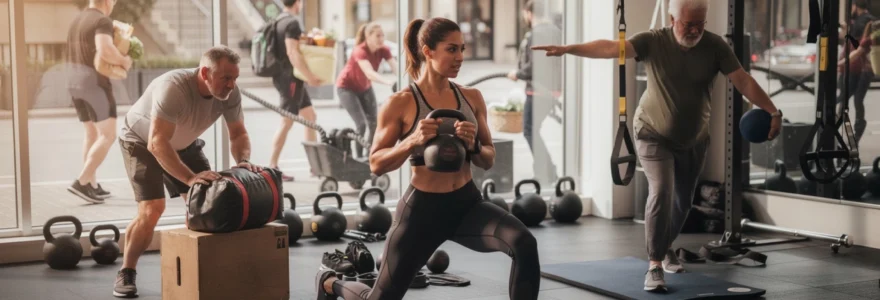
Modern fitness culture often emphasises isolated muscle groups and aesthetic achievements, yet millions of individuals struggle with basic daily movements despite impressive gym statistics. Functional fitness represents a paradigm shift towards training that directly translates to improved quality of life, focusing on movement patterns you perform every day rather than merely building muscle mass. This training methodology prepares your body for real-world demands, from carrying groceries to playing with children, whilst reducing injury risk and enhancing overall physical competence. The growing recognition of functional training’s superiority in improving activities of daily living has sparked renewed interest among fitness professionals and health-conscious individuals alike.
Functional movement patterns and Multi-Planar exercise mechanics
Traditional gymnasium environments typically emphasise single-plane movements that isolate specific muscle groups, yet human movement operates through complex, multi-directional patterns. Understanding the biomechanical principles underlying functional movement patterns provides the foundation for developing comprehensive training programmes that mirror real-world activities. The human body moves through three distinct planes of motion: sagittal (forward and backward), frontal (side to side), and transverse (rotational), each requiring coordinated muscular activation and neuromuscular control.
Functional movement patterns encompass seven fundamental movements: squat, lunge, hinge, push, pull, gait, and rotation. These patterns form the basis of virtually every daily activity, from rising from a chair to lifting objects overhead. The integration of these movement patterns through structured training develops the muscular strength, coordination, and stability necessary for optimal physical function throughout life.
Sagittal plane dominance in traditional gym training versus Tri-Planar functional movements
Most conventional resistance training exercises operate predominantly within the sagittal plane, limiting movement to forward and backward directions. Bench presses, bicep curls, and leg extensions exemplify this approach, creating muscular imbalances and movement deficiencies when performed exclusively. Research indicates that sagittal plane dominance contributes to increased injury rates and reduced functional capacity in real-world scenarios requiring multi-directional movement.
Tri-planar functional movements address these limitations by incorporating lateral, rotational, and diagonal movement components. Exercises such as lateral lunges with rotation, multi-directional step-ups, and medicine ball throws challenge the neuromuscular system across all movement planes. This comprehensive approach develops the dynamic stability and coordinated movement patterns essential for navigating complex environments safely and efficiently.
Kinetic chain integration through compound movement patterns
The human body functions as an interconnected kinetic chain, where movement in one segment influences adjacent structures throughout the entire system. Compound movement patterns engage multiple muscle groups simultaneously, promoting kinetic chain integration and functional strength development. These movements create synergistic muscle activation patterns that closely mirror the demands placed on the body during daily activities.
Deadlift variations exemplify kinetic chain integration by simultaneously engaging the posterior chain, core stabilisers, and upper extremity muscles. This coordinated muscle activation develops functional strength that transfers directly to activities such as lifting heavy objects from the ground or maintaining proper posture during prolonged sitting. The emphasis on movement quality over isolated muscle development distinguishes functional training from traditional bodybuilding approaches.
Proprioceptive training and neuromuscular control development
Proprioception, often termed the body’s « sixth sense, » refers to the awareness of body position and movement in space. This sensory system plays a crucial role in maintaining balance, coordinating complex movements, and preventing injuries during dynamic activities. Functional training protocols specifically target proprioceptive development through unstable surface training, single-limb exercises, and perturbation-based movements.
Research demonstrates that proprioceptive training significantly improves reaction time, balance control, and movement efficiency. Exercises performed on unstable surfaces, such as balance boards or foam pads, challenge the proprioceptive system and enhance neuromuscular control mechanisms. The development of superior proprioceptive awareness translates to improved performance in sports activities and reduced fall risk among older adults.
Core stability versus core strength in functional movement systems
The distinction between core stability and core strength represents a fundamental concept in functional training methodology. Core strength refers to the maximal force
strength the trunk musculature can generate, while core stability describes the ability to control the spine and pelvis under load and during movement. In functional movement systems, stability takes precedence, as it enables efficient force transfer between the upper and lower body without energy leaks or compensatory patterns. You can think of core strength as the size of an engine and core stability as the quality of the chassis that keeps everything aligned and under control.
Functional fitness programmes therefore emphasise anti-movement exercises—such as planks, side planks, Pallof presses, and loaded carries—that train the core to resist unwanted motion in all three planes. These drills teach your deep stabilising muscles to fire at the right time and in the right sequence, which is crucial when you twist to reach into the back seat of a car or brace to pick up a heavy box. By prioritising core stability over pure abdominal strength, functional training reduces the risk of low back pain, improves posture, and enhances performance in both sports and daily tasks.
Evidence-based physiological adaptations from functional training protocols
Beyond improved movement quality, functional fitness induces a range of physiological adaptations that are well documented in exercise science literature. When you consistently perform multi-joint, multi-planar exercises, your nervous system, muscles, connective tissues, and cardiovascular system all adapt in an integrated fashion. These adaptations explain why a functional workout that looks deceptively simple can leave you breathing hard, sweating, and feeling muscles you did not realise you had. Understanding these evidence-based changes helps you appreciate how functional training supports long-term health, performance, and resilience in everyday life.
Functional training protocols have been shown to enhance intermuscular coordination, increase motor unit recruitment, and improve metabolic and cardiovascular efficiency. At the same time, they stimulate beneficial changes in tendons, ligaments, and fascia that contribute to joint stability and injury prevention. When we shift the focus from isolated muscle fatigue to whole-system adaptation, we create fitness that is durable, transferable, and highly relevant to real-world activities.
Intermuscular coordination and motor unit recruitment patterns
Intermuscular coordination refers to how effectively different muscles work together to produce and control movement. In traditional isolation training, a single muscle group is often targeted while stabilisers and synergists play a minimal role. In contrast, functional fitness continually challenges multiple muscles to cooperate, much like a well-rehearsed orchestra rather than a solo performance. This enhanced coordination means you can produce more force with less effort and lower your risk of awkward, uncontrolled movements.
On a neural level, functional exercises improve motor unit recruitment patterns by training your nervous system to engage the right fibres at the right time. Complex tasks such as stepping laterally while rotating with a medicine ball require rapid communication between your brain and muscles. Over time, this leads to faster reaction times, smoother movement transitions, and greater efficiency in activities of daily living. For example, getting in and out of a car, changing direction while walking, or quickly catching yourself during a trip all become easier and more automatic.
Metabolic conditioning through High-Intensity functional training
High-intensity functional training (HIFT) combines compound movements performed at relatively high effort with minimal rest, creating a potent form of metabolic conditioning. Because these workouts use large muscle groups and multiple joints, they demand more oxygen and energy than small, isolated movements. The result is a significant elevation in heart rate and oxygen consumption, often in a shorter time frame than traditional steady-state cardio. For busy adults, this makes functional circuits an efficient way to improve both strength and cardiorespiratory fitness.
Several studies have shown that HIFT can improve VO₂ max, anaerobic capacity, and excess post-exercise oxygen consumption (EPOC), which means you continue burning calories after you finish training. Think of it as teaching your body to become a more efficient hybrid engine, switching seamlessly between fuel systems during your day. Incorporating short, well-designed functional circuits—such as squats, step-ups, loaded carries, and rowing variations—two to three times per week can significantly improve your ability to climb stairs, carry loads, and sustain physical tasks without feeling breathless.
Connective tissue adaptation and injury prevention mechanisms
Muscles are only one part of the picture; tendons, ligaments, and fascia also adapt to the stresses of functional exercise. When you perform controlled, multi-directional movements, these structures experience varied loading patterns that stimulate collagen remodelling and increased tensile strength. Over time, this helps joints tolerate unpredictable forces, such as when you suddenly change direction to avoid an obstacle or catch a falling object. In this sense, functional training acts as an insurance policy for your joints, preparing them for the unexpected.
Functional strength training also addresses muscle imbalances and movement asymmetries, which are common precursors to overuse injuries and joint pain. Exercises like single-leg deadlifts, lunges with rotation, and step-downs highlight side-to-side differences and encourage more symmetrical loading. By deliberately improving alignment, joint positioning, and load distribution, you reduce the strain on vulnerable structures such as the knees, hips, and lower back. The outcome is fewer aches and pains, fewer “mystery tweaks,” and greater confidence in your ability to move safely in everyday life.
Cardiovascular efficiency in functional movement circuits
Functional movement circuits—where you transition between different compound exercises with limited rest—provide a powerful cardiovascular stimulus while simultaneously building strength. Because these circuits frequently involve standing movements, changes of direction, and whole-body actions, they train the heart and lungs in a way that closely mirrors real-world demands. Instead of sitting on a machine, you are walking, lifting, pushing, pulling, and stabilising, just as you would in your daily routine. This integrated challenge teaches your cardiovascular system to support full-body effort rather than isolated segments.
Research indicates that circuit-style functional training can improve stroke volume, capillary density, and heart rate recovery, all markers of cardiovascular health. You may notice practical changes such as being able to walk longer distances, climb several flights of stairs, or complete yard work with less fatigue. Importantly, these sessions can be scaled to your current fitness level by adjusting work intervals, rest periods, and exercise complexity. As your conditioning improves, you simply progress the difficulty, ensuring a sustainable and engaging path to better heart health.
Crossfit and tactical athlete training methodologies
CrossFit and tactical athlete training programmes (such as those used by military, police, and firefighters) are often cited as real-world examples of functional fitness in action. Both approaches emphasise readiness for unpredictable physical challenges, ranging from sprinting and climbing to carrying heavy loads over uneven terrain. Instead of specialising in a single skill, these methodologies cultivate broad-based capacity: strength, power, endurance, mobility, and resilience. While they differ in culture and application, they share a commitment to functional movements performed at varying intensities.
CrossFit popularised the concept of performing constantly varied, functional movements at high intensity, incorporating exercises like squats, deadlifts, Olympic lifts, push-ups, pull-ups, and rowing. Tactical training borrows many of these same patterns but tailors them to occupational tasks such as dragging a casualty, scaling obstacles, or wearing heavy protective equipment. For everyday individuals, the lesson is not necessarily to replicate these extreme demands, but to recognise how functional training can be scaled and adapted to build practical preparedness. Whether you are a parent lifting a child or a first responder carrying gear, the underlying movement patterns remain remarkably similar.
At the same time, both CrossFit and tactical methodologies highlight the importance of progression, technique, and recovery. Poor coaching or excessive intensity can increase injury risk, particularly with complex lifts and high training volumes. If you are interested in these styles of functional fitness, seeking qualified instruction, mastering foundational movements, and respecting your current capacity are essential. When approached intelligently, these systems can provide a highly motivating framework for building the type of fitness that not only looks impressive, but also performs when it matters most.
Activities of daily living enhancement through specific movement protocols
One of the most compelling reasons to adopt functional fitness is its direct impact on your activities of daily living (ADLs). ADLs include tasks such as getting out of bed, standing up from a chair, climbing stairs, carrying shopping bags, and picking items up from the floor. When these seemingly simple actions become difficult, independence and quality of life can quickly decline. Functional training uses targeted movement protocols to strengthen the exact patterns required for these everyday tasks, making life feel easier, safer, and more enjoyable.
For example, squats and sit-to-stand drills directly translate to rising from a chair or toilet, while step-ups and step-downs improve your ability to navigate stairs with confidence. Hinge patterns and deadlift variations teach you how to pick up objects from the ground without straining your back—whether that is a suitcase, a child, or a laundry basket. Pushing and pulling movements, such as incline presses and rows, support actions like opening heavy doors, pushing a shopping trolley, or pulling a garden bin. By practising these patterns regularly, you build a reservoir of functional capacity that you can draw on all day long.
Balance and gait-related exercises also play a crucial role in maintaining independence, especially as we age. Single-leg stands, tandem walks, and rotational lunges challenge your stability and help prevent falls—a leading cause of injury in older adults. Core stability drills and loaded carries reinforce upright posture and trunk control, which are vital for walking longer distances and standing for extended periods. When you view functional fitness through the lens of ADLs, the goal becomes clear: to ensure you can move through your environment with ease, handle unexpected demands, and stay active on your own terms for as long as possible.
Functional movement screen assessment and corrective exercise implementation
Before diving into advanced functional exercises, it is essential to understand your current movement capacity and any limitations you may have. The Functional Movement Screen (FMS) is one widely used assessment tool that evaluates fundamental patterns such as squatting, lunging, stepping, reaching, and core stability. Rather than focusing on how much weight you can lift, the FMS scores how well you move—highlighting asymmetries, mobility restrictions, and control deficits. Think of it as a “movement report card” that guides smarter, more individualised training decisions.
During an FMS or similar assessment, a trained professional observes your body alignment, joint range of motion, and coordination under controlled conditions. The goal is not to pass or fail, but to identify the most efficient starting point for your functional fitness journey. Perhaps your overhead mobility limits safe pressing, or a lack of hip stability compromises your single-leg balance. Once these issues are known, we can prioritise corrective exercises that address the root causes rather than simply working around the symptoms.
Corrective exercise implementation typically involves a blend of mobility drills, stability work, and low-load patterning exercises designed to retrain your nervous system. For instance, someone with poor ankle mobility and knee valgus in a squat might benefit from calf and hip mobility work, followed by supported squats to a box to groove better mechanics. Over time, as movement quality improves, these corrective drills are gradually integrated into more demanding functional patterns. This process is similar to rebuilding a house from the foundation up; once the base is solid, additional load and complexity can be added safely.
Incorporating periodic movement screens into your routine also provides a valuable feedback loop. As you progress through your functional training plan, reassessment can confirm that your interventions are working and guide any necessary adjustments. This evidence-based approach reduces guesswork and helps ensure that your efforts in the gym translate to meaningful improvements in everyday life. By respecting the sequence of assess, correct, then load, you create a sustainable pathway to functional fitness that supports long-term health, performance, and independence.
 Good health cannot be bought, but rather is an asset that you must create and then maintain on a daily basis.